

Design Futures · Speculative UX · Systems Thinking · Ethics
Designing Systems of Control in Unequal Societies
Exploring how design mediates power, surveillance, and compliance through speculative systems analysis
OVERVIEW
This speculative UX case study examines how design systems can reinforce power, surveillance, and inequality within highly structured societies. Using The Hunger Games as a conceptual lens, the project shifts focus from individual narratives to the systems that shape behaviour, perception, and control at scale.
1
THE DESIGN QUESTION
How might design systems reinforce or resist power, control, and inequality in societies where choice is deliberately constrained?
2
CONTEXT & SCENARIO

The world of Panem operates as a fictional but internally consistent system where design is embedded into governance. Spatial segregation, ritualised selection processes, broadcast media, and symbolic architecture are intentionally designed to reinforce authority and discourage collective resistance.
This project treats the scenario as a lens, not a narrative reference, allowing real-world tensions to surface around surveillance, propaganda, behavioural conditioning, and unequal access to safety and resources.
Panem map

3
CULTURAL ANALYSIS (METHOD)
To understand how values and power are embedded into the system, the project used the CULTURA framework to analyse authority, behaviour, symbolism, and social norms.
This helped translate fictional dynamics into real UX concerns such as trust, compliance, and exclusion.
CULTURA framework diagram

4
PERSONAS ( System Roles )
Personas were created to represent different relationships to power, visibility, and control. Rather than personal goals, they highlight how risk and agency vary across groups within the system.

5
SYSTEMS OF CONTROL
Rather than focusing on individual users, this project analyses interconnected systems that collectively maintain authority and suppress resistance.

Several patterns emerged
Centralised Authority
Power reinforced through symbolic dominance and spatial hierarchy
Ritualised Participation
Coercive processes framed as civic duty
Environmental Control
Designed spaces that limit autonomy while appearing neutral
Environmental Control
Designed spaces that limit autonomy while appearing neutral
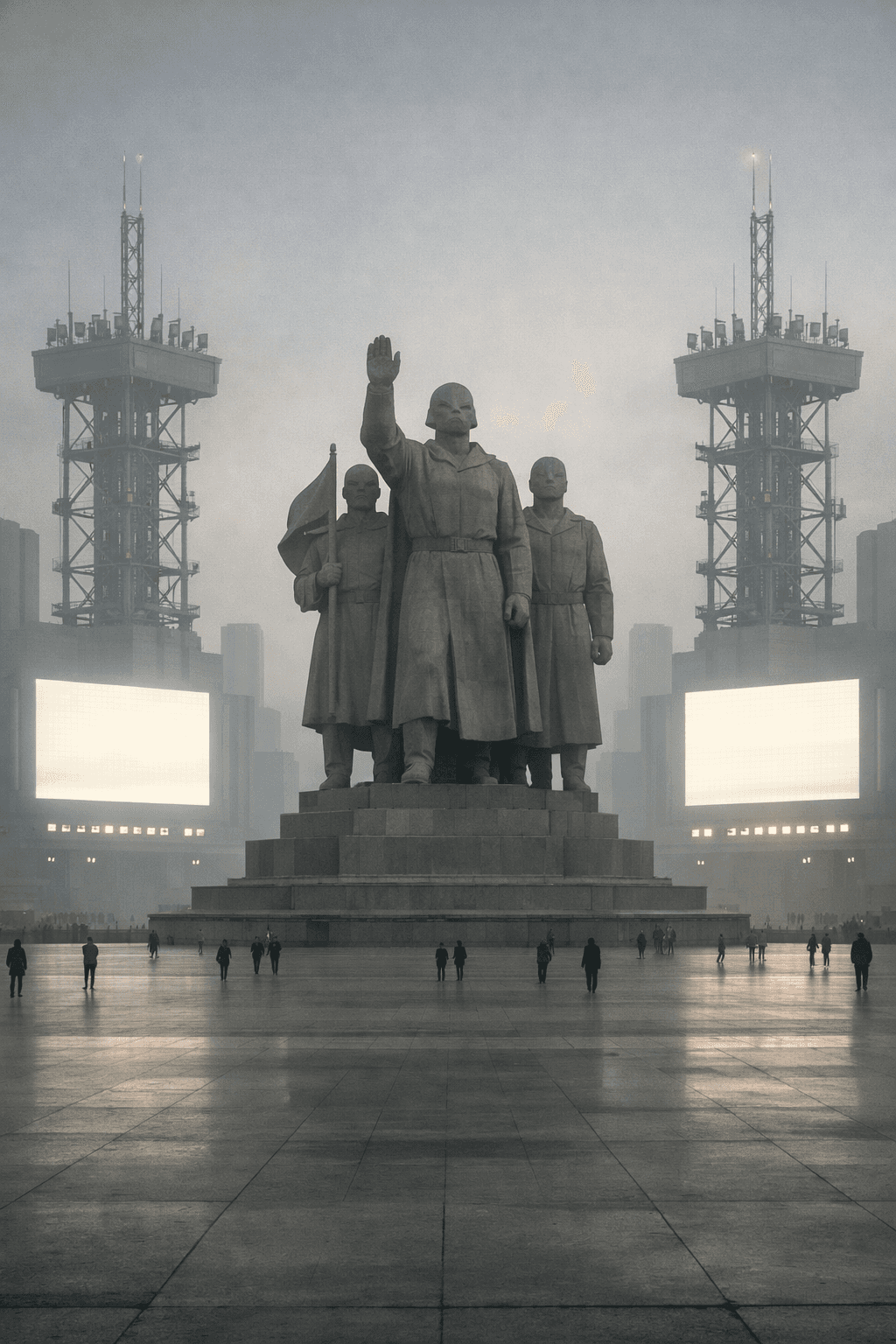
6
SPECULATIVE SYSTEM ARTEFACTS
Speculative artefacts were introduced to translate abstract systems of control into tangible interactions. These artefacts are not proposed products, but critical design probes used to expose how authority, surveillance, and participation are mediated through design.
They function as tools for questioning—not solutions.
Speculative artefacts used to examine control, visibility, and compliance.
Voice & Surveillance

VoiceBox
Emotional Exposure

Hologram in public space
Immersive Perspective

VR headset sketches
7
ETHICAL TENSIONS & TRADE-OFFS
Rather than presenting technology as a neutral solution, this project surfaces the ethical tensions that emerge when safety, participation, and control are mediated through systems.
By distributing decision-making across interfaces, sensors, and simulations, the system raises critical questions about power, responsibility, and unintended consequences.
These tensions are not framed as problems to be solved, but as design constraints that shape how such systems should be approached.
Key Ethical Tensions
Surveillance vs Safety
Increased monitoring may reduce immediate risk, but persistent surveillance risks normalising observation beyond moments of crisis. What begins as protection can evolve into control.
Efficiency vs Human Agency
Automated alerts and system-driven responses improve coordination, yet may reduce space for human judgement, dissent, or refusal—particularly in high-pressure situations.
Empathy vs Manipulation
Immersive and emotional technologies can foster understanding, but they also raise questions about emotional coercion and whether empathy can be engineered ethically.
Access vs Inequality
Safety technologies may disproportionately benefit those with greater resources or political power, reinforcing existing inequalities rather than reducing them.
8
REFLECTION: DESIGNING FOR CONSEQUENCES, NOT OUTCOMES
This project intentionally avoids proposing a single “ideal” solution.
Instead, it treats UX design as a tool for:
Revealing hidden power structures
Making ethical trade-offs visible
Designing for uncertainty rather than optimisation
By using speculative environments, the work reframes UX from interface design to systems thinking, where responsibility is shared across people, infrastructure, and governance.
9
LEARNINGS & DESIGN TAKEAWAYS
Designing for systems requires prioritising relationships, not features
Ethics must be treated as a design material, not a post-deployment concern
Fictional extremes can reveal real-world design failures more clearly than realistic scenarios
UX can shape behaviour indirectly by structuring visibility, trust, and participation
10
Waleed Sohail Ansari
UX & Visual Designer
Based in the
Open to junior / graduate roles
Let's connect
Exploration Areas
3D & Spatial Experiments
Motion & Kinetic Design
UX Case Studies
© 2026 Waleed Sohail Ansari — Designed & built by me